
A building can look complete, pass inspection and still fall short of what its owner needs. Equipment may operate correctly on its own but fail when it must respond as part of an integrated system. Controls may not follow the intended sequence. In a laboratory or other high-performance facility, a small gap in airflow, pressure control or alarm response can become a major operational problem.
Building commissioning is the systematic quality-assurance process used to find those gaps and verify that building systems meet the Owner’s Project Requirements. The right type of commissioning depends on the facility’s age, commissioning history, operational needs and current performance.
Some projects need commissioning from early design through occupancy. Others call for a structured investigation of an existing building, a periodic performance tune-up or ongoing analysis of building data. Understanding the differences helps owners put the right process, and the right expertise, in place.
What Is Building Commissioning?
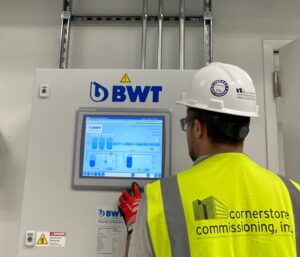
Building commissioning is more than a final inspection or a one-time equipment startup. It is a coordinated process of planning, review, verification, testing, issue tracking, documentation and training. The commissioning authority, or CxA, evaluates individual components and, just as important, the way systems perform together.
For new construction, that work can begin during design and continue through construction, acceptance and the warranty period. For existing buildings, the commissioning process may begin with investigation and diagnostics, followed by corrective work and performance verification.
At Cornerstone, we approach commissioning as an independent, hands-on advocate for the owner. The design team remains responsible for design, and contractors remain responsible for installation and correction of their work. Our role is to lead and document verification, identify performance gaps and confirm that corrective work produces the required result.
What Are the Main Types of Building Commissioning?
Commissioning terminology varies across organizations and project specifications. In practice, most owner needs fit within four categories:
- New construction commissioning (NCCx)
- Existing building commissioning or retro-commissioning (EBCx or RCx)
- Recommissioning and ongoing commissioning (ReCx or OCx)
- Monitoring-based commissioning (MBCx)
These categories can overlap. A facility may complete recommissioning, for example, and then use monitoring-based commissioning to watch key performance indicators. The label is less important than a scope built around the facility’s actual requirements.
New Construction Commissioning
New construction commissioning is integrated into the planning, design, construction and turnover of a new facility or major renovation. This is where commissioning has its greatest opportunity to influence the finished building. Questions resolved during design are usually easier to address than problems discovered after installation or occupancy.
Early CxA involvement gives the owner the greatest opportunity to influence performance. During design, the CxA can review requirements, system selections, sequences of operation and maintainability before equipment is purchased or installed.
During construction, commissioning commonly includes submittal reviews, site observations, issue tracking and pre-functional checks. Functional performance testing then challenges systems under normal, transitional and failure scenarios. It is not enough to know that a fan starts or a valve opens. Owners need to know how equipment, controls, alarms and safety features respond together when conditions change.
Typical deliverables include:
- Owner’s Project Requirements support and a commissioning plan
- Design, submittal and field-verification records
- Functional performance test procedures and results
- Functional performance test procedures and results
- Operations staff training and turnover documentation
This is an important part of the Cornerstone approach. We perform pre-functional equipment checks and verifications ourselves. That direct field involvement gives the owner a clear picture of whether installed systems are truly ready for integrated testing.
Existing Building Commissioning and Retro-Commissioning
An occupied building can continue operating for years while hidden performance problems increase energy use, create comfort complaints or weaken reliability. Existing building commissioning, often called retro-commissioning, applies to facilities that were not previously commissioned or do not have reliable commissioning records. The process investigates current operation, identifies those problems and verifies the results of corrective actions.
Triggers include persistent comfort complaints, unexpected energy use, frequent alarms, control-system changes, renovations or a change in facility use. Even a building that appears to operate normally may have sensors, dampers or redundant systems that do not respond correctly under every condition.
An EBCx or RCx engagement typically begins with document review, staff interviews, trend analysis and site investigation. The team develops findings, coordinates corrective work and retests affected systems.
Common deliverables include:
- Current-facility requirements and an existing-conditions assessment
- A prioritized findings and opportunities log
- Diagnostic and functional test results
- Recommendations and verification of implemented corrections
- Updated system documentation and staff guidance
Drawings and sequences tell us how a building was intended to work. Retro-commissioning shows the owner how it performs today.
Recommissioning and Ongoing Commissioning
Buildings do not remain static after turnover. Occupancy changes. Equipment is replaced. Operators adjust schedules and setpoints. Sensors drift. Recommissioning applies to a previously commissioned building and revisits performance after these changes or other signs of operational drift.
Unlike retro-commissioning, recommissioning starts with a known performance baseline when prior records remain available. The CxA reassesses selected systems, adapts functional tests, documents deficiencies and verifies corrections.
Ongoing commissioning extends that mindset into facility operations. Its scope and frequency should reflect the building’s risk profile, requirements and rate of change.
Facility operators help the CxA distinguish intentional decisions from unwanted performance drift. Their involvement also makes documentation and training more useful.
Monitoring-Based Commissioning
Monitoring-based commissioning uses building automation, utility, equipment and environmental data to evaluate performance over time. Analytics can reveal patterns that may be difficult to capture during a single test event—but more data does not automatically create better building performance.
Depending on the facility and available data, MBCx may support detection of issues such as:
- Simultaneous heating and cooling
- Equipment operating outside scheduled hours
- Unstable temperature, humidity or pressure control
- Sensor drift or conflicting sensor values
- Control sequences that do not respond as intended
- Excessive cycling or persistent alarms
Monitoring does not replace engineering judgment or hands-on verification. An alert tells the team where to look; it does not, by itself, establish the cause. Effective MBCx pairs meaningful rules and trends with a defined process for review, prioritization, corrective action and verification.
Owners should address sensor coverage, data access, trend intervals and staff responsibilities early. MBCx can be especially useful where small performance changes have significant consequences.
Commissioning Critical Building Systems
Commissioning scopes are also described by the systems included. Depending on the Owner’s Project Requirements, testing may address HVAC equipment, building automation, electrical infrastructure, lighting controls, plumbing, fire and life-safety interfaces and specialized systems.
The details at the interfaces often reveal the most important problems. A supply fan may start correctly while the complete system fails to maintain required room pressure when doors open, filters load or another fan fails. Functional performance testing evaluates these interactions under realistic conditions.
Commissioning for Mission-Critical and Biocontainment Facilities
Mission-critical and biocontainment facilities are specialized applications of the types above. This is where the details matter most. Environmental and safety requirements make system integration, repeatability and documentation especially important.
For a BSL-3 laboratory, the scope may include directional airflow, room-pressure relationships, HVAC failure responses, alarm behavior, door interlocks, exhaust systems and HEPA filtration where applicable to the design. Testing should reflect the facility’s risk assessment, operating procedures and applicable project requirements. Biosafety professionals and facility operators should be involved so the verification plan reflects how the laboratory will actually be used.
For an operating facility, verification should account for research schedules, containment needs and permitted outages. Thoughtful sequencing and recovery procedures can reduce disruption while preserving rigor.
What Are the Stages of the Commissioning Process?
Clients sometimes ask whether commissioning has seven stages, eight stages or a numbered set of levels. There is no universal stage count that fits every project. Cornerstone organizes its work around four practical phases:
- Program and design: Establish requirements, review the design and define verification criteria.
- Construction: Review installation, complete hands-on pre-functional checks and track issues.
- Acceptance: Perform functional testing under real or simulated operating scenarios and verify corrections.
- Post-acceptance: Support turnover, documentation, training and continued performance during occupancy or warranty.
Likewise, “Level 4 commissioning” is not a universal commissioning type with one industrywide definition. If a specification uses numbered levels, owners should require the project documents to define the systems, tests, responsibilities, acceptance criteria and deliverables associated with each level.
Choosing the Right Commissioning Approach
Start with the condition the owner needs to verify:
- Choose new construction commissioning for a new facility or major renovation, preferably beginning during planning or design.
- Choose existing building commissioning or retro-commissioning when a facility lacks a commissioning baseline or has unresolved performance concerns.
- Choose recommissioning when a previously commissioned building needs periodic revalidation or has experienced operational change.
- Choose ongoing or monitoring-based commissioning when the owner needs a repeatable process for identifying and addressing performance drift over time.
The strongest scope defines measurable requirements, critical systems, operating scenarios, documentation needs and owner responsibilities. It also considers what happens after the commissioning team leaves. A technically successful project should leave the facility staff with the knowledge and documentation needed to maintain performance.
A Hands-On Third-Party Partner for High-Performance Facilities
Every high-performance facility is different. The commissioning process should respect those differences rather than forcing a standard checklist onto a specialized building.
Cornerstone Commissioning A TSS Company brings independent, owner-focused expertise to new and existing buildings throughout the United States. Since 2001, we have built deep experience in laboratories, healthcare spaces, university science facilities, biocontainment environments and other mission-critical buildings.
Through design review, direct pre-functional verification, functional performance testing, issue resolution, documentation and staff coordination, we help simplify complex facilities and verify that building systems meet operational requirements.
Learn more about our services or contact Cornerstone Commissioning to discuss the right approach for your facility.