
For facility directors and engineers, the period between installation and occupancy carries significant risk. Equipment may look complete but still have incorrect settings, missing safeties or unresolved controls. In a mission-critical facility, discovering those problems during operation can disrupt research and delay turnover.
Understanding pre-commissioning vs commissioning helps owners establish the right sequence. Pre-commissioning prepares individual equipment and systems for functional testing. Commissioning is the broader quality-focused process that begins during planning and design and continues through construction, acceptance and post-occupancy activities. Together, they help verify that the facility is safe to test and capable of meeting the Owner’s Project Requirements.
Pre Commissioning vs Commissioning: A Quick Comparison
| Area | Pre-Commissioning | Commissioning |
|---|---|---|
| Primary purpose | Verify installation, startup readiness and component condition | Verify that integrated building systems meet owner requirements |
| Typical timing | During construction, before functional performance testing | From planning and design through occupancy and warranty |
| Main focus | Individual equipment, connections, controls and prerequisites | System operation, interactions, failure response and documentation |
| Typical activities | Inspections, flushing, pressure tests, calibration and pre-functional checks | Design reviews, functional tests, issue resolution, training and turnover |
| Operating state | Often static or partially energized; some checks require startup or power | Includes live, controlled operation in normal and failure modes |
| Main output | Completed checklists and readiness status | Test records, issues log and final commissioning report |
The terms vary among contracts, so project documents should define the boundary. Pre-commissioning is not a substitute for the full process, and not every pre-functional activity is strictly de-energized.
What Is Mechanical Completion?
Mechanical completion is a contractual milestone indicating that specified construction and installation work is substantially complete and ready for the next defined activities. It may apply to an individual component, a system or an area rather than the entire project at once.
Before documenting mechanical completion, the responsible team should verify the agreed criteria. Records may include inspections, pressure and leak tests, startup documents, calibration records, redlined drawings and outstanding punch items.
The precise sequence should follow the specifications. Some checks occur progressively as equipment becomes available rather than waiting for one project wide completion date.
Typical Pre-Commissioning Activities
Pre-commissioning activities confirm that equipment and systems are installed correctly and ready for integrated testing. The scope should be tailored by system and risk level. Common activities include:
- Inspecting equipment for damage and confirming access and labeling
- Flushing piping and documenting cleanliness where required
- Completing leak and pressure testing for piping systems
- Verifying electrical grounding, insulation resistance and connections
- Checking fan and motor rotation, alignment and vibration
- Calibrating sensors and confirming control-point mapping
- Exercising valves, dampers, actuators and safety devices
- Reviewing startup documentation and test-and-balance readiness
For laboratory process equipment and specialty utilities, the checklist may also address compressed air, vacuum, laboratory gases, process cooling water or other project-specific systems.
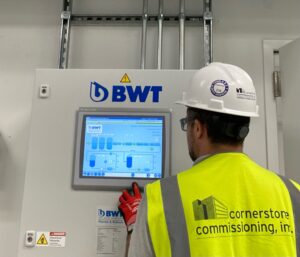
Cornerstone’s hands-on approach is important here. Our team performs pre-functional equipment checks and verifications directly rather than relying solely on forms completed by others. That field involvement gives the owner a clearer picture of whether a system is actually ready for functional testing.
Managing Punch Lists and the Handover to Testing
A disciplined workflow keeps incomplete work from following the project into commissioning. Each item should identify the system, condition, responsible party, priority, due date and closure evidence.
Digital tracking improves traceability, but software does not close an issue; the team must verify the correction. Safety-critical and test-blocking items should be resolved before functional testing begins.
Tagging issues by phase makes ownership clearer and prevents duplicate records.
Commissioning and Startup: Live System Verification
Startup places equipment into operation according to manufacturer and project requirements. Commissioning then challenges the system under controlled conditions to verify that components work together as intended.
Functional performance tests may evaluate occupied and unoccupied modes, load changes, alarms, interlocks, power loss, equipment failure, redundancy and recovery. Energization and ramp-up should be staged, monitored and supported by the appropriate contractors and vendors. Test procedures need defined prerequisites, steps, expected outcomes and pass/fail criteria.
Stable operation needs a project-specific definition, such as maintaining temperature, humidity, pressure or airflow within approved limits for a stated period. Results and retests become part of the record.
Training should occur while systems are available for demonstration. Operators need to understand sequences, alarms, trends and failure responses—not simply receive manuals at turnover.
How Many Stages Does Commissioning Have?
There is no universal stage count. The same lifecycle may be grouped in several useful ways:
- Four phases: program and design, construction, acceptance, and post-acceptance
- Five phases: pre-design, design, construction, acceptance, and post-occupancy
- Seven practical steps: planning, design review, installation verification, pre-functional checks, functional testing, turnover, and ongoing verification
The labels are less important than maintaining the full sequence. The process should begin with clear owner requirements, verify installation before functional testing, document issue closure and prepare operators to maintain performance after occupancy.
Common Problems to Avoid
Projects lose value when teams rush energization, begin functional testing with incomplete pre-functional work or carry major punch items into acceptance. Other problems include vague criteria, unclear responsibilities and disconnected issue logs.
Early engagement of an independent commissioning authority helps owners define the scope, verify readiness and maintain an objective line of sight across designers, contractors and vendors. This is particularly valuable for mission-critical systems, where a missed interface can have consequences well beyond comfort.
Commissioning the Cornerstone Way
Cornerstone Commissioning A TSS Company provides independent, third-party commissioning for high-performance facilities throughout the United States. With more than 1,200 projects in our portfolio, we understand the details that determine whether laboratories, healthcare environments, university science buildings and other complex facilities are truly ready for operation.
Our work spans design review, construction verification, hands-on pre-functional checks, functional performance testing, issue resolution, documentation and operator coordination. We look out for the owner’s best interests while helping the full project team deliver a building that meets its operational requirements.
The key distinction is simple: pre-commissioning establishes readiness; commissioning verifies performance. Owners need both activities coordinated within one clear, traceable process.
Learn more about our services or contact us to discuss your facility today.