
A facility can be complete on paper and still not be ready to support its mission. Equipment may start but fail to respond correctly when connected to other systems. Controls may not follow the intended sequence. Operators may receive incomplete documentation just as they assume responsibility for the building.
For laboratories, healthcare environments, university science centers and other mission-critical facilities, these gaps can affect safety, containment, research continuity, energy use and regulatory compliance. Finding them after occupancy is often more disruptive than addressing them during design and construction.
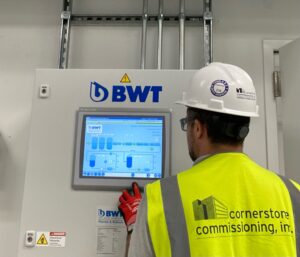
The building commissioning process provides a structured way to verify performance throughout the project lifecycle. This guide explains the process for facility directors, engineers and owners who need complex building systems to function as intended. It also shows how Cornerstone Commissioning A TSS Company serves as an independent, hands-on commissioning authority focused on the owner’s operational requirements.
What Is Building Commissioning?
Building commissioning is a quality-focused process used to verify and document that systems are planned, designed, installed, tested and capable of operating according to the Owner’s Project Requirements, or OPR.
Commissioning is not a final inspection or equipment startup. It begins before design decisions are fixed and continues through construction, acceptance, training and occupancy. The commissioning authority, or CxA, provides an objective view of performance, documents deficiencies and verifies corrective work.
New construction commissioning applies to new facilities, additions and major renovations. Existing building commissioning investigates systems already in operation. Retro-commissioning, or RCx, is commonly used when an existing building was never formally commissioned or lacks a useful baseline. Recommissioning, or ReCx, revisits a facility that was previously commissioned.
Why Commissioning Matters for Mission-Critical Facilities
All buildings depend on coordinated systems, but mission-critical facilities have less tolerance for error. A pressure-control failure in a BSL-3 laboratory can interrupt research and require immediate response.
Commissioning evaluates the interfaces where important problems often hide. A supply fan may operate correctly on its own while the complete HVAC system fails to maintain room pressure during an exhaust-fan failure. An emergency generator may start while downstream equipment fails to transfer as required. An alarm may appear at the building automation system but not reach the person responsible for acting on it.
Testing these interactions supports safer operation and regulatory readiness. Commissioning can also identify incorrect schedules, sensor errors and other conditions that waste energy. The objective is to deliver a building that staff can understand, operate and maintain.
What Are the Main Types of Commissioning?
The three main types are often summarized as:
- New construction commissioning: Integrates verification into planning, design, construction, acceptance and turnover.
- Existing building or retro-commissioning: Investigates and corrects performance problems in an operating facility that lacks a prior commissioning baseline.
- Recommissioning or ongoing commissioning: Revalidates previously commissioned systems or maintains performance through periodic review and corrective action.
Monitoring-based commissioning, or MBCx, supports ongoing work by using building data to identify performance drift. The right approach depends on facility condition, risk, goals and available documentation.
Building Commissioning Process: Five Phases and Seven Practical Steps
Some resources describe five phases of commissioning: pre-design, design, construction, acceptance and post-occupancy. Others describe seven steps. Both can be correct because one framework groups activities that another separates.
Cornerstone’s process follows the full lifecycle. For this guide, the five phases are organized into seven practical steps:
Pre-design → design → construction → testing and acceptance → occupancy and optimization
Step 1: Define the OPR and Commissioning Scope
The process starts with the owner. The OPR describes what the facility must accomplish and becomes the benchmark for design reviews, verification and acceptance.
The OPR may address:
- Temperature, humidity, ventilation and pressure relationships
- Occupancy, process loads and operating schedules
- Redundancy and failure-response expectations
- Energy and water performance goals
- Maintainability, access and replacement needs
- Alarm, trending and reporting requirements
- Operator training and turnover documentation
- Applicable codes, standards and policies
The owner should also identify systems, test depth and acceptance authority. Approval checkpoints keep the OPR current as decisions change. Budgets and schedules established now help prevent scope reductions late in construction.
Step 2: Form the Commissioning Team and Plan the Work
The team commonly includes the owner, CxA, architects, engineers, construction manager, contractors, controls provider, testing and balancing contractor, vendors and operators. Mission-critical projects may also involve biosafety officers and process specialists.
Roles must be explicit. A responsibility matrix identifies who prepares, performs, witnesses, approves and closes each activity. The owner should appoint one communication lead, while the CxA reports findings directly to the owner.
The commissioning plan establishes scope, responsibilities, schedule, communications, documentation and issue management. Templates, file naming and version control should be selected early. The plan evolves with the project.
Step 3: Review the Design and Basis of Design
The Basis of Design, or BOD, explains how the design responds to the OPR. During design, the CxA reviews drawings, specifications, equipment selections and sequences of operation for alignment with the owner’s requirements.
At defined design milestones, the CxA may flag:
- Conflicting or incomplete control sequences
- Equipment sizing or redundancy concerns
- Missing alarms, trends or failure modes
- Access limitations that affect maintenance or testing
- Interfaces between HVAC, controls, electrical and life-safety systems
- Requirements that cannot be verified as written
Comments do not replace the design team’s responsibility. They provide an independent performance review while changes remain practical. The BOD, OPR and plan should evolve together, and commissioning requirements must be incorporated into project specifications.
Step 4: Verify Installation During Construction
Once construction begins, commissioning moves from documents into the field. The CxA reviews relevant submittals, observes installation, attends coordination meetings and maintains an issues log.
Cornerstone’s hands-on approach is a key differentiator during this phase. We perform pre-functional equipment checks and verifications ourselves rather than relying only on completed contractor forms. Field observations may cover equipment location and access, piping and ductwork, sensors, dampers, valves, controls, labeling, electrical connections and safety devices.
Schedules should align with equipment delivery, startup, testing and balancing, and functional testing. Findings should identify the requirement, condition, responsible party, due date and closure evidence. Regular reporting keeps unresolved issues visible.
Step 5: Complete Pre-Functional Checks
Pre-functional checklists confirm that individual components are installed, started and ready for integrated testing. This step prevents functional testing from becoming an expensive troubleshooting session.
Checks may include:
- Startup documentation and manufacturer requirements
- Sensor calibration and control-point mapping
- Fan rotation, belt condition and filter installation
- Valve and damper movement
- Setpoints, safeties and alarm routing
- Equipment labeling and BAS communication
- TAB readiness and completion status
Each item needs an acceptance criterion. Failed items remain open until corrected and verified. A system should not advance to functional testing simply to protect the schedule.
Step 6: Perform Functional Performance Testing
Functional performance testing is the point at which individual components must demonstrate that they work together as a system. The CxA develops test procedures from the OPR, BOD and approved sequences of operation. Contractors and vendors support testing, but the CxA directs the verification and records results.
Tests should address normal operation, transitions and credible failures, including changes in load, power loss, equipment failure, alarm response and recovery. Seasonal conditions may require later warranty-period testing.
Every test should state prerequisites, steps, expected results and pass/fail criteria. Actual outcomes, corrections and retests belong in the project record. A passed test without traceable results provides limited value.
Step 7: Complete Acceptance, Training and Ongoing Verification
Commissioning does not end when testing is finished. Before acceptance, the CxA confirms issue status and prepares a final commissioning report. Remaining items should be clearly assigned and tracked rather than disappearing into a general punch list.
Turnover materials include test records, the issues log, O&M manuals, sequences, controls documentation and training records. Training should cover system operation, alarms, trends and failure response.
After occupancy, warranty review and seasonal testing can reveal new conditions. A plan for recommissioning, ongoing commissioning or MBCx helps extend the original work.
Monitoring-Based Commissioning and Continuous Optimization
MBCx uses automation, meter and sensor data to evaluate operation over time. Indicators may include energy use, environmental stability, room pressures, runtime and alarms.
Analytics can identify simultaneous heating and cooling, after-hours operation or unstable control. An alert is not a diagnosis; the team must investigate, correct and verify the condition.
MBCx requires reliable data and assigned responsibility for action. Without that process, dashboards create noise rather than improvement.
Systems Commonly Included in Commissioning
Scope varies by project, but commonly commissioned building systems include:
- HVAC equipment, air and water distribution, and specialty exhaust
- Building automation, controls, alarms and trending
- Electrical distribution, emergency power and transfer systems
- Lighting and lighting controls
- Plumbing, domestic hot water and applicable water-treatment systems
- Fire and life-safety interfaces
- Renewable-energy and metering systems
- Laboratory gases, compressed air, vacuum and other process utilities
The greatest value comes from verifying interfaces, so the OPR and specifications should define system boundaries and integrated scenarios.
Special Considerations for Biocontainment Laboratories
Every biocontainment facility is different, so commissioning begins with the facility’s risk assessment and intended use. For a BSL-3 laboratory, the team may verify directional airflow, room-pressure relationships, supply and exhaust failure responses, alarms, door interlocks, HEPA filtration and decontamination or process systems where applicable.
Pass/fail criteria should be established before testing. Failure scenarios must reflect the risk assessment, operating procedures and required response of staff. Tests should also account for occupied areas, research schedules and permitted outages.
The commissioning record should connect requirements, tests, findings, corrections and acceptance. Because regulatory and institutional requirements differ, the documentation register should identify authorities, reviewers, update frequency and retention periods.
Common Commissioning Pitfalls
Recurring problems include:
- Hiring the CxA after major design decisions are complete
- Using an OPR with vague or unmeasurable criteria
- Leaving roles and acceptance authority unclear
- Omitting commissioning requirements from specifications
- Treating contractor checklists as proof of independent verification
- Starting functional testing before systems are ready
- Failing to allow time for corrections and retesting
- Delivering documentation that operators cannot search or use
- Closing issues administratively without verifying the result
Early CxA engagement, a clear responsibility matrix and consistent reporting address many of these problems. The process works best when commissioning is integrated into the construction process rather than treated as a separate event near turnover.
How Much Does Building Commissioning Cost?
There is no universal percentage. Cost depends on facility type, system complexity, number of test scenarios, project schedule, travel, phasing and whether work occurs in an operating environment.
As one benchmark, the 2020 GSA Commissioning Guide lists commissioning-provider fees for laboratories at approximately 0.9% to 2.5% of construction cost. Those figures cover provider services and are not a quote for every project; design-team, contractor and owner participation may create additional costs.
Owners should compare proposals by scope, not percentage alone. A lower fee may exclude design review, direct field verification, integrated testing or issue closure. Returns can include lower energy waste, fewer callbacks, reliable operation and reduced disruption. For a mission-critical facility, avoided downtime or a verified failure response may be more valuable than energy savings.
Commissioning the Cornerstone Way
Cornerstone Commissioning provides independent, third-party expertise for new construction, renovations and existing buildings throughout the United States. Our portfolio includes laboratories, pharmaceutical and research environments, healthcare facilities, university science buildings and other mission-critical spaces.
We tailor the commissioning process to the facility rather than forcing every project into the same checklist. Our services include OPR support, design review, commissioning planning, direct pre-functional verification, functional performance testing, issue resolution, documentation, operator coordination, retro-commissioning and monitoring-based commissioning.
With Cornerstone, owners gain a hands-on advocate focused on the details that determine whether a building truly works.
Learn more about Cornerstone’s commissioning services or contact us to discuss your facility today.