A building can earn recognition for sustainable design, but owners ultimately operate the finished facility, not the design documents. Equipment must be installed correctly. Controls must follow the intended sequences. Mechanical and electrical systems must work together under real operating conditions.
That is where commissioning fits into a LEED project. For facility directors and engineers responsible for laboratories, healthcare spaces, university science buildings, and other high-performance facilities, the process connects sustainability goals with verifiable system performance.
Cornerstone Commissioning serves as an independent commissioning provider focused on the owner’s requirements. We review, observe, test, and document how systems perform so the project team can address gaps before they become operational problems.
What Is LEED Commissioning?
LEED commissioning is a documented quality-assurance process used to verify that a project’s building systems are designed, installed, tested and capable of operating in accordance with the Owner’s Project Requirements.
LEED stands for Leadership in Energy and Environmental Design. The U.S. Green Building Council’s rating system provides a framework for healthier, more efficient buildings. Commissioning connects those design goals to installed performance.
It can reveal incorrect setpoints, incomplete installation, and control-sequence conflicts that increase energy use or affect ventilation, comfort, and reliability. It also creates a record for LEED review and future operation.
Fundamental Commissioning Versus Enhanced Commissioning
For LEED Building Design and Construction projects, Fundamental Commissioning and Verification is a prerequisite. It establishes the baseline process: develop and review the Owner’s Project Requirements and Basis of Design, prepare a commissioning plan, incorporate requirements into construction documents, test systems, maintain an issues log, and prepare a final report.
The governing standard also depends on the registered version. LEED v4.1 references ASHRAE Guideline 0-2013, while ASHRAE has since published Guideline 0-2019. Project teams should follow the standard named in their applicable LEED requirements.
Enhanced Commissioning is an optional credit pathway that adds activities supporting long-term performance. Depending on the LEED version and pathway, it may include earlier provider involvement, submittal review, operator-training verification, seasonal testing, an ongoing commissioning plan, monitoring-based commissioning, or building enclosure commissioning.
Point values are version-specific. LEED v4 and v4.1 BD+C offer pathways totaling up to six points for Enhanced Commissioning. Under LEED v5 BD+C: New Construction, the credit structure changed and currently offers up to four points. Owners should confirm the registered rating system and current credit language before setting the scope or forecasting points.
The LEED Commissioning Process: Six Practical Phases
Commissioning is sometimes summarized in five stages: planning, design, construction, acceptance, and occupancy. No universal count fits every delivery method, however, and the activities matter more than the number. These six practical phases separate installation checks from functional testing and turnover.
Phase 1: Planning and Pre-Design
The Owner’s Project Requirements, or OPR, describe how the facility must perform, including environmental conditions, energy goals, occupancy, redundancy, maintainability, and training needs.
The commissioning authority should be engaged early. LEED v4.1 requires a qualified CxA by the end of design development; newer pathways may call for appointment even earlier. This gives the CxA time to understand owner priorities before major decisions are locked in.
Phase 2: Design Review and Coordination
The CxA reviews the OPR, Basis of Design, drawings, specifications, and sequences for gaps that could prevent systems from meeting owner requirements. High-risk areas may include HVAC capacity, controls integration, pressure relationships, alarm logic, and failure response.
Phase 3: Construction Verification
During construction, the CxA reviews relevant submittals, observes installation, and tracks deficiencies through resolution.
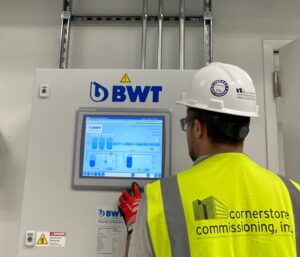
Cornerstone takes a hands-on approach during this phase. We perform pre-functional equipment checks and verifications ourselves rather than relying solely on completed contractor forms. This gives the owner a direct, third-party confirmation of system readiness.
Phase 4: Pre-Functional Checks
Pre-functional checklists confirm that components are installed, started, and ready for integrated testing. Checks may cover settings, sensor calibration, control points, valve and damper movement, safeties, and building-automation communication. Resolving these details early reduces avoidable retesting.
Phase 5: Functional Performance Testing
Functional performance testing challenges systems under normal, transitional, and failure conditions using approved sequences and clear acceptance criteria. Equipment may be tested under different loads, schedules, and modes. A fan starting is not enough; the team may need to verify how airflow, pressure, alarms, and redundant equipment respond when a component fails.
Phase 6: Documentation, Training and Handover
The final report summarizes the scope, results, unresolved items, and completed corrections. Training and operations documentation help facility staff understand how systems are intended to work.
For Enhanced Commissioning, turnover may include additional systems-manual content, seasonal testing, post-occupancy review, or an ongoing commissioning plan, depending on the selected version and pathway.
What Systems Are Included in LEED Commissioning?
The scope depends on the rating system and project. LEED v4.1 Fundamental Commissioning addresses mechanical, electrical, plumbing, and renewable-energy systems as they relate to energy, water, indoor environmental quality and durability. Typical systems include:
- HVAC equipment, distribution and controls
- Building automation and energy-management systems
- Interior and exterior lighting controls
- Domestic hot-water and applicable plumbing systems
- Electrical distribution and metering
- On-site renewable-energy systems, when included
The exterior enclosure receives limited treatment within the fundamental v4.1 requirements. Full building enclosure commissioning is an enhanced option. Because LEED v5 changed the requirements, teams should verify their registered version rather than reuse an old checklist.
How Do You Get LEED Certification?
At a high level, the owner selects the appropriate LEED rating system and version, registers the project, completes all prerequisites, pursues selected credits, documents compliance and submits the application for Green Business Certification Inc. review. The final point total determines the certification level: Certified, Silver, Gold, or Platinum.
Commissioning is one part of that larger effort, but it is the part that asks a practical question: Does the finished building perform the way the owner needs it to?
Commissioning the Cornerstone Way
Cornerstone provides independent, third-party commissioning for laboratories, pharmaceutical, and research facilities, healthcare spaces and other high-performance buildings throughout the United States. Our services include design review, hands-on pre-functional verification, functional performance testing, issue resolution, documentation, operator coordination, and monitoring-based commissioning.
Every facility is different. We tailor the process to the project’s LEED requirements, operational priorities, and risk profile while looking out for the owner’s best interests.
Learn more about Cornerstone’s LEED commissioning services or contact us to discuss your project.